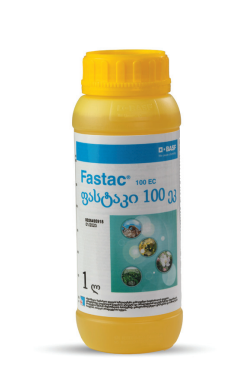
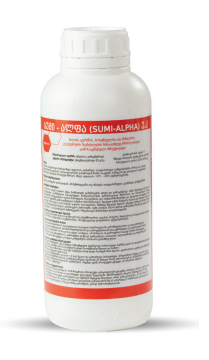
Non-systemic insecticide with contact and digestive action
Active ingredient: alfa-cypermethrin 100 g/l
Formulation: emulsifiable concentrate EC
Mode of action:
Alpha-cypermethrin, a synthetic pyrethroid, acts like naturally occurring pyrethrum on the nervous system of insects. The nervous system serves to transmit information in the organism.
The affected insect is thus subject to uncoordinated movements and finally death. Alpha-cypermethrin is active against both piercing-sucking and chewing insects. The effect is triggered by the insects contact with, or ingestion of the active ingredient. In addition to its effect on mature and immature insects Alpha-cypermethrin has also demonstrated a significant ovicidal effect. The excellent knock-down and residual control of Alphacypermethrin products are complemented by a strong repellent effect on pests. Because the effect of Alpha-cypermethrin is increased at lower temperatures, Alpha-cypermethrin products can also ideally be used under cool climatic conditions. Due to low solubility in water and excellent rainfastness the product is not washed off plant surfaces by rain. This means that a high degree of control can be achieved in unfavorable climatic conditions.
Application:
Alpa-cypermethrin is used for the control of most important crop-infesting insect species of the out of the groups of Homoptera, Heteroptera, Lepidoptera, Coleoptera, Diptera and Thysanoptera.
Cereals – against aphids (Aphididae spp.), thrips (Thysanoptera spp.), cereal leaf beetle (Oulema melanopus), in a dose of 0,1 – 0,15 l/ha at the time of attendance of young larvae.
Apple, pear – against apple roll (Cydia pomonella), 5-7 days after the maximum number of butterflies caught with pheromone traps or at the beginning of the first caterpillars hatching; aginst fall webworm (Hyphanthria cunea) at the beginning of the sawing of the first caterpillars; against aphids (Aphididae spp.) at the beginning of the formation of the first colonies; in a dose of 0,1-0,25 l/ha.
Grape – against vine moth (Eupoecillia ambiguella) after sawing the first larvae, and before drilling, in a dose of 0,12-0,15 l/ha.
Cabbage – against diamondback moth (Plutella xylostella) when the first caterpillars are noticed, in a dose of 0,08-1,12 l/ha.
Peach – against oriental fruit moth (Cydia molesta) before boring the caterpillar into the fruits and shoots, in a dose of 0,1-0,15 l/ha; against fall webworm (Hyphanthria cunea) at the beginning of the sawing of the first caterpillars in a dose of 0,1-0,15 l/ha.
Cucumber – against greenhouse whitefly (Trialeurodes vaporariorum) when the first imagoes observed in a dose of 0,2-0,25 l/ha.
Perennial plants – against greenhouse whitefly (Trialeurodes vaporariorum) when the first imagoes observed in a dose of 0,2-0,25 l/ha; against thrips (Thysanoptera spp.) when the first imagoes observed in a dose of 0,12-0,18 l/ha.
52
Application advantages:
- – Effective against insects resistant to other insecticides
- – It exhibits repellent and “antifeeding” action
- – It does not exhibit phytotoxicity in recommended doses
- – It works longer than classic insecticides
- – Highly resistant to rain washing
- – Low doses reduce environmental pollution
- – Slightly dangerous for species that are not the object of treatment
Mixing:
It must not be mixed with Bordeaux mixture and alkaline reaction products.
Waiting period (pre harvest period in days): 14 days for potatoes, tomatoes, cucumbers and fruit trees, 21 days for the vine, 28 days for cabbage, sugar beet, 35 days for cereals 42 days for citrus fruits and oilseed rape
Packing: 1 L


 Agrimatco.georgia@agrimatco-eu.com