Agrimatco.georgia@agrimatco-eu.com

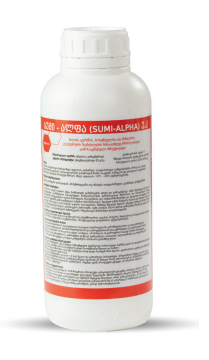
Active ingredient: esfenvalerate 50 g/l
Formulation: emulsifiable concentrate EC
Mode of action:
The active ingredient mimics the effect of pyrethrins which is a natural insecticide derived from the chrysanthemum flower. Esfenvalerate interferes with the insect’s nerve cells, which leads to paralysis and prevents the insect from performing normal functions like feeding and grooving.
Application:
Cereals – against aphids (Aphididae), grain flea (Chaetocnema aridula), grain bender (Cnephasia sp.), cereal leaf beetle (Oulema melanopus), thrips (Thysanoptera), in a dose of 0,2-0,25 l/ha
Peas, beans – against black beet aphid (Aphis fabae), pea green aphid (Acyrthosiphon pisi), pea weevil (Bruchus pisi), thrips (Thrips sp.), when the first insects appear; black pea bender (Laspeyresia nigricana), in phenophase of young pods and again after 15 days; pea fly (Contarinia pisi), It is applied when insects appear in the phenophase of flower buds in a dose of 0,2-0,3 l/ha.
Apple – against apple aphid (Rhopalosiphum prunifolii), apple green aphid (Aphis pomi), apple aphid (Dysaphis plantaginea), It is applied at the beginning of the attack (before or after flowering) in a dose of
0,5 – 1 l/ha. (Cydia molesta ) Carrot – against (Trioza viridula) in a dose of 0,2-0,3 l/ha
Potatoes – against Colorado (Leptinotarsa decemlineata), It is applied at the appearance of the first larvae or adult developmental stages only in areas where there is no resistance to pyrethroids, with treatment at intervals of 15 days, in a dose of 0,15-0,25 l/ha.
Cabbage – against cabbage white (Pieris brassicae), cabbage moth (Plutella xylostella), It is applied at the appearance of the first signs of attack when the caterpillars are in their younger development stages, in a dose of 0,2 l/ha.
Onion, garlic – against the onion bulb fly (Eumerus strigatus) in a dose of 0,2-0,3 l/ha
Citrus fruit – against citrus whitefly (Dialeurodes citri), in a dose of 0,75-1 l/ha; and against (Lecanidae spp.) in a dose of 1,25-2,5 l/ha.
Registered in EU:
Peach – against green peach aphid (Myzus persicae), peach louse curler (Aphis varians), peach black aphid (Brachycaudus persicaecola), plum green aphid (Hyalopterus arundinis), peach brown aphid (Anuraphis schwartzi), It is applied at the beginning of the attack (before or after flowering), in a dose of 0,2-0,25 l/ha. Against peach bender (Cydia molesta), It is applied at the time of the emergence of the caterpillars from the eggs, and then at an interval of 12 days, in a dose of 0,3 l/ha. Apricot – against peach moth (Anarsia lineatella), in a dose of 0,3 l/ha.
Against plum green aphid (Hyalopterus arundinis), peach brown aphid (Anuraphis schwartzi), It is applied at the beginning of the attack (before or after flowering), in a dose of 0,25 l/ha.
Application advantages:
Esfenvalerate is a specific pyrethroid insecticide with properties that distinguish it from most other pyrethroids:
58
- • Full effectiveness with lower doses than standard pyrethroids.
- • The specific chemical structure of a molecule that is the basis for: – The strongest repellent effect among pyrethroids.
– Greater safety for beneficial insects and pollinators. – Less tendency for insect resistance to develop.
– Most pyrethroids have a common pyrethrin core structure. Esfenvalerate contains a unique phenyl-acetate radical, which is also the basis for:
- • Intense repellent effect
- • Increased safety for beneficial insects
- • Resistance to pyrethroids is known, especially in aphid populations. Esfenvalerate, with its special molecular structure (phenyl-acetate radical), represents a lower risk for the development of insect resistance compared to other pyrethroids.
- – It is recommended to alternate preparations with different modes of action in order to prevent the development of resistance.
- – Hachiman 50 WG is the ideal partner for alternation in aphids’ control
Packing: 1 L