Agrimatco.georgia@agrimatco-eu.com

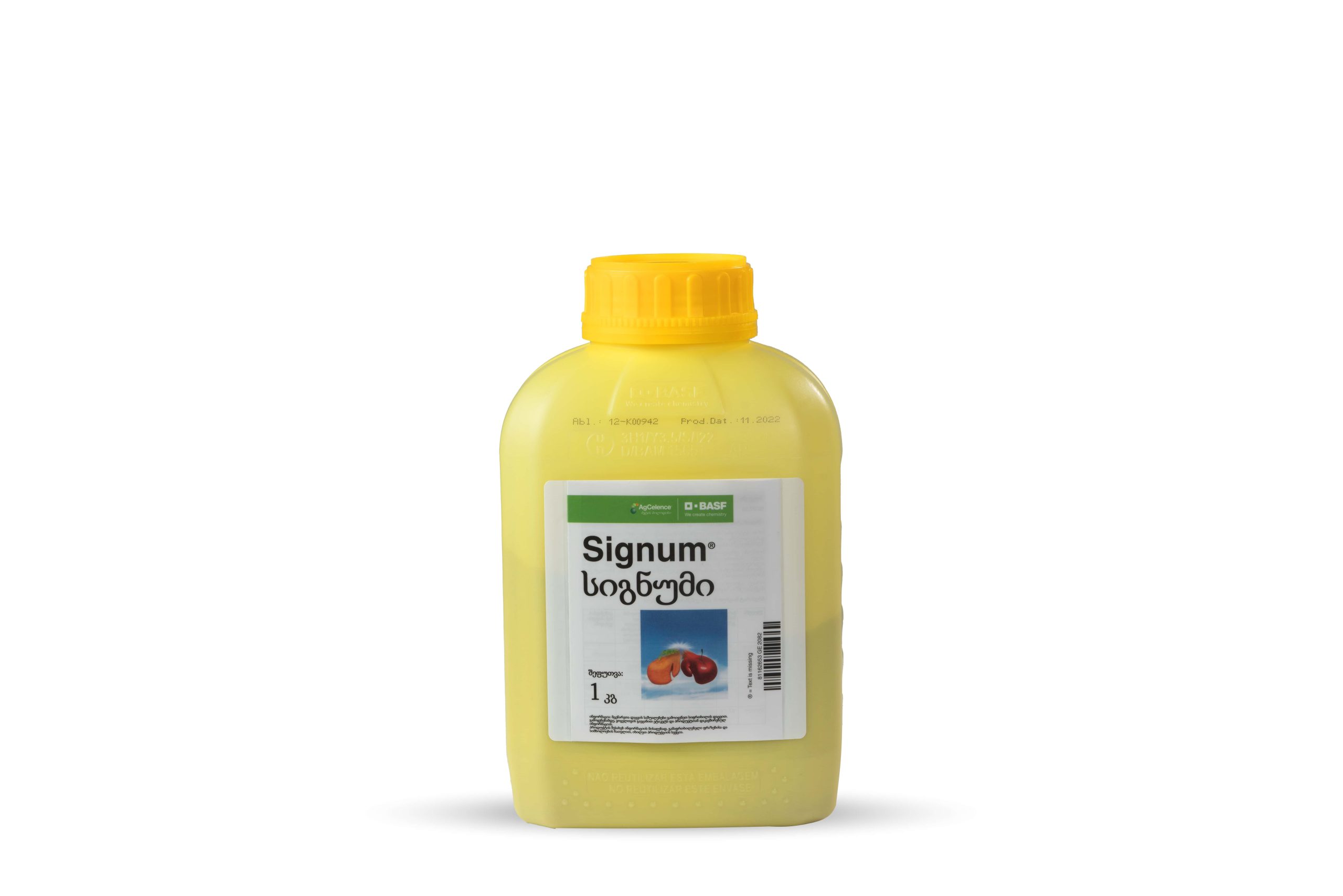
Fungicide with the widest spectrum of application on the market, suppresses the most economically significant diseases in fruits and vegetables.
Active ingredient: boscalid 267 g/kg + pyraclostrobin 67 g/kg
Formulation: water dispersible granules WG
Mode of action:
Signum® is fungicide with two active ingredients, boscalid and pyraclostrobin. Boskalid belongs to the group of carboxyamides, and according to the mechanism of action, it is an inhibitor of electron transport in mitochondria, namely in complex 2 (SDHI). Pyraclostrobin belongs to the methoxycarbamate group, and according to its mechanism of action, it disrupts the normal process of electron transport in complex 3 (cytochrome bc1-ubiquinone oxidase at the Qo site). Acting on the respiration process, but in different places, allows Signum® to have one of the widest spectrums of application and to suppress the most economically significant diseases in fruit and vegetable growing. The high selectivity towards cultivated plants provides the possibility of application during the entire growing season, from the early stages of plant development to just before harvest. Timely application ensures healthy plants, better fruit quality, and thus easier and longer storage.
Application:
Peach – for the suppression of the cause of drying of flowers, fruit branches (Monilinia laxa) and brown
rot of fruits (Monilinia fructigena) in a dose of 1 kg/ha, with a water consumption of 600-1000 l/ha (6-10
l/100 m²).
Time of application: preventively, before infection occurs, from the phenophase of the appearance of the flower balloon to full flowering (BBCH 59–65/67) and/or during fruit ripening (BBCH 85/87).
Apricot – for the suppression of the cause of drying of flowers, fruit branches and brown rot of stone fruits (Monilinia laxa) and fruit rot (Monilinia fructigena) in a dose of 1 kg/ha, with a water consumption of 600-1000 l/ha (6- 10 l/100 m²).
Time of application: preventive, before infection, from the phenophase of full flowering (at least 50% of flowers open) to the phenophase of fruit development: fruits about half of the final size (BBCH 64–75). Sour Cherry – to control the cause of drying of flowers, fruit branches and brown rot of fruits (Monilinia laxa) in a dose of 1-1,25 kg/ha, with a water consumption of 600-1000 l/ha (6-10 l/100 m²).
Time of application: preventive, before infection, first treatment at the beginning of flowering (10% of flowers open), second treatment in the pre-flowering phenophase, flowers shrivel, most flowers fall (BBCH 61-67).
Cherry and plum: to control the cause of fruit rot (Monilinia fructigena) in a dose of 1-1,25 kg/ha, with a water consumption of 600–1000 l/ha (6–10 l/100 m²).
Time of application: preventively, during the growing season, from the phenophase of visible crown leaves with individual white flowers to the phenophase of fruits ripe for consumption with a typical taste and color characteristic of the variety (BBCH 57–89).
37
Strawberry and raspberry: to suppress the cause of gray rot (Botrytis cinerea) in the amount of 1.5 kg/ha, with a water consumption of 300–600 l/ha (3–6 l/100 m²).
Time of application: preventively, during the growing season, from the phenophase of flowering, pre-flowering, formation and ripening of fruits (BBCH 65–87).
Tomatoes: for the control of potato and tomato black spots (Alternaria solani), tomato leaf mold (Fulvia fulva) and gray rot (Botrytis cinerea) in a dose of 1-1.5 kg/ha, with a water consumption of 200-600 l/ ha (2–6 l/100 m²).
Application time: first treatment at the beginning of the infection, second and third treatment 7-10 days after the first and second treatment, respectively. It is mandatory to open and ventilate the greenhouse or greenhouse, and then use Signum®.
Onion: to control the cause of downy mildew (Peronospora destructor) and gray rot (Botrytis cinerea) in a dose of 1-1,5 kg/ha, with a water consumption of 200–400 l/ha (2–4 l/100 m²).
Time of application: preventively, before infection occurs, from the phenophase of the development of the first true leaf to the phenophase when the root and thickened stem reaches 70% of the final diameter (BBCH 11–47).
Carrots: for the control of black leaf spot (Alternaria dauci) and powdery mildew (Erysiphe heraclei) in the amount of 0,5 – 1 kg/ha, with a water consumption of 200–400 l/ha (2–4 l/100 m²).
Time of application: preventively, before infection occurs, from the phenophase of the development of the first true leaf to the phenophase when the root and thickened stem reaches 70% of the final diameter (BBCH 11–47).
Cabbage – against ring spot (Mycosphaerella brassiciola) and cabbage spot (Alternaria brassicae) in the amount of 1 – 1,5 kg/ha in 500 l of water/ha.
Potatoes: for control of potato and tomato black spots (Alternaria solani) in the amount of 0.25 kg/ha, with a water consumption of 200–400 l/ha (2–4 l/100 m²).
Application time: preventive, at the latest at the beginning of the infection, second treatment 2-3 weeks after the first treatment.
Registered in EU:
Lettuce: to control the cause of blight (Bremia lactucae) in a dose of 1.5 kg/ha, with a water consumption of 200–400 l/ha (2–4 l/100 m²).
Time of application: preventively, before infection occurs, from the phenophase of the third leaf development to the phenophase when 70% of the plants have varietal characteristics.
Celery: to control the cause of gray leaf spot (Septoria spp.) in a dose of 1 kg/ha, with a water consumption of 200–400 l/ha (2–4 l/100 m²).
Time of application: preventively, before infection occurs, from the phenophase of the development of the first true leaf to the phenophase when the root and thickened stem reaches 70% of the final diameter (BBCH 11–47).
Parsley: to control the cause of black leaf spot (Alternaria spp) in a dose of 1 kg/ha, with a water consumption of 200–400 l/ha (2–4 l/100 m²).
Time of application: preventively, before infection occurs, from the phenophase of the first true developed leaf to the phenophase when the root and thickened stem reaches 70% of the final diameter (BBCH 11–47). Walnut: for controlling the causes of black spot (Alternaria spp), gray necrosis (Fusarium lateritium), anthracnose (Colletotrichum spp), black rot (Cladosporium spp.), black leaf and fruit spot of walnut (Gnomonia leptostyla) in a dose of 1 kg/ha, with a water consumption of 1000–1500 l/ha (10–15 l/100 m²).
Time of application: preventive, before infection, from the phenophase of the beginning of flowering to 90% of the fruits formed (BBCH 61-79).
Hazelnuts: for controlling the causes of black spot (Alternaria spp), gray necrosis (Fusarium lateritium), anthracnose (Colletotrichum spp), black rot (Cladosporium spp.) in a dose of 1 kg/ha, with a water consumption of 600–1000 l/ha (6–10 l/100 m²).
Time of application: preventive, before infection, from the phenophase of the beginning of flowering to 90% of the fruits formed (BBCH 61-79).
Application advantages:
– Fungicide with the widest range of applications on the market
38
- – Suppresses the most economically important diseases in fruits and vegetables
- – Better fruit quality – easier storage and transport
- – It improves the condition of plants even when there are no conditions for disease development – the AgCelence® effect
Waiting period (preharvest period in days): cherry and plum – 3 days; peach, apricot, strawberry, raspberry and blueberry – 7 days; cherries, potatoes, tomatoes, onions, lettuce and parsley – 14 days hazelnut and walnut – 28 days
Packing: 1 kg, 500 gr